


A collision with an 80,000-pound tractor-trailer doesn’t play by the same rules as a fender-bender between two sedans. The physics are different, the injuries tend to be far more severe, and figuring out who’s actually responsible often involves more than just the driver. Understanding the common types of truck accidents – and who can be held liable for each – is the first step toward protecting a claim.
Common Types of Truck Accidents
Not all truck accidents happen the same way, and the type of accident often points directly to what went wrong. These are among the most frequent types of truck accidents seen on New York roads and highways:
| Accident Type | What Happens | Common Cause |
| Jackknife | Trailer swings out at an angle to the cab, often during hard braking | Sudden braking, wet roads, improper load balance |
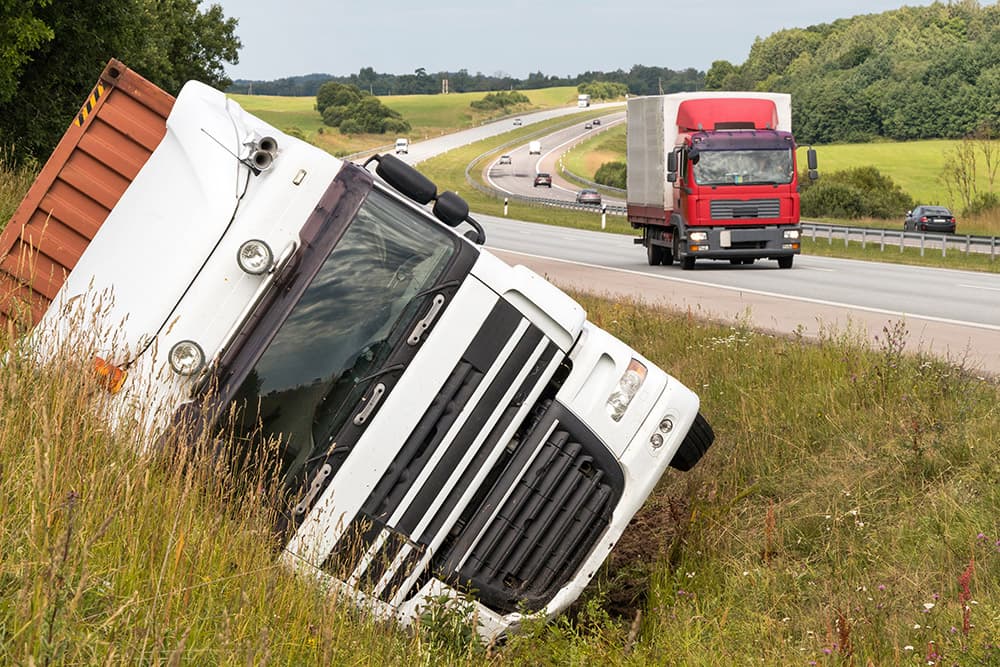
| Rollover | Truck tips onto its side or roof, often on a curve or ramp | Excessive speed, high center of gravity, overloaded cargo |
| Underride | A smaller vehicle slides partially or fully under the trailer | Sudden stops, inadequate rear or side underride guards |
| Rear-End | Truck strikes another vehicle from behind, or is struck from behind | Following too closely, delayed braking due to truck weight |
| Tire Blowout | A tire failure causes loss of control | Poor maintenance, overloading, worn tires |
| Blind Spot Collision | Truck merges or turns into a vehicle in one of its large blind spots | Failure to check mirrors, inadequate signaling |
| Overloaded Cargo | Improperly loaded or secured cargo shifts or falls | Exceeding weight limits, poor load securement |
A jackknife truck accident, truck rollover accident, underride truck accident, rear end truck accident, truck tire blowout accident, and truck accident blind spot collision each leave behind a different evidence trail – which is exactly why identifying the accident type early matters for building a strong claim.
Truck Accident Causes: Why These Crashes Happen
Truck accident causes generally fall into a few recurring categories, and identifying which one applies to your accident is often central to building a claim. Common causes of truck accidents include:
- Truck driver negligence – following too closely, distracted driving, or failing to account for the truck’s longer stopping distance
- Driver fatigue – a driver fatigue truck accident is a persistent risk in the industry, which is exactly why federal hours-of-service regulations exist in the first place
- Drunk or impaired driving – a drunk truck driver accident carries catastrophic potential given the size and weight differential involved
- Speeding truck accident scenarios – traveling too fast for road or weather conditions reduces a truck’s already-limited ability to stop or maneuver
- Poor vehicle maintenance – brake failure and tire blowouts are frequently traced back to inadequate inspection or upkeep
- Improper cargo loading – overloaded or unbalanced cargo increases rollover and jackknife risk significantly
The Federal Motor Carrier Safety Administration has studied semi truck accident causes extensively, and its research consistently points to a mix of driver-related factors (like being unfamiliar with the roadway or having to stop unexpectedly) and vehicle-related factors (like brake problems) as recurring contributors to large truck crashes. Broader truck accident statistics from FMCSA and NHTSA reinforce the same pattern year after year.
Who Is Liable in a Truck Accident?
Truck accident liability is rarely as simple as “the driver was at fault.” Because commercial trucking involves multiple parties with distinct legal responsibilities, who is responsible for a truck accident often requires investigating several potential defendants at once.
Parties who may share truck accident liability include:
- The truck driver, for negligent or reckless operation
- The trucking company, for negligent hiring, inadequate training, or pressuring drivers to violate hours-of-service rules
- A cargo loading company, if improperly secured cargo contributed to the crash
- A maintenance or repair company, if faulty repairs or missed inspections played a role
- The truck or parts manufacturer, if a defective component caused or worsened the crash
Example: Trucking Company Liability for Driver Fatigue
A tractor-trailer driver hauling goods into Brooklyn falls asleep at the wheel after logging hours well beyond federal limits, rear-ending a line of stopped traffic. Records later show the trucking company routinely pressured drivers to exceed legal driving hours to meet delivery deadlines. In a case like this, trucking company liability can extend well beyond the driver, since the company’s scheduling practices directly contributed to the crash.
Example: Underride Accident Involving a Third-Party Loader
A sedan is severely damaged in an underride accident after a tractor-trailer makes a sudden stop on the Brooklyn-Queens Expressway. Investigation reveals the trailer’s rear underride guard had been improperly installed by a third-party maintenance contractor months earlier. Liability in this scenario may extend to the maintenance company, not just the trucking company or driver.
Can You Sue a Trucking Company?
Yes – can you sue a trucking company is one of the most common questions after a serious truck accident, and the answer is generally yes, provided the company or its driver was negligent. Trucking companies typically carry substantial commercial insurance policies, which is one reason these cases are often more heavily contested than standard car accident claims.
Truck Accident Lawsuit Process: What to Expect
The truck accident lawsuit process generally follows a similar structure to other personal injury claims, though the investigation phase tends to be more involved given the number of potential defendants and the importance of preserving evidence before it disappears.
- Seek immediate medical attention and document all injuries
- Preserve evidence quickly – trucking companies may not be required to retain black box and driver log data indefinitely, so early legal action matters
- Identify all potentially liable parties, which may include the driver, trucking company, maintenance contractor, or manufacturer
- File a claim with the relevant insurance carriers, which for commercial trucks often involves significantly higher policy limits than standard auto insurance
- Negotiate a settlement based on medical costs, lost wages, and the severity of the injury
- If a fair settlement isn’t reached, proceed to litigation, particularly for cases involving catastrophic injury
Frequently Asked Questions
What are the most common types of truck accidents? Jackknife accidents, rollovers, underride crashes, rear-end collisions, tire blowouts, and blind spot collisions are among the most frequent types of truck accidents on New York roads.
Who is liable in a truck accident involving a commercial driver? Liability can extend to the driver, the trucking company, a cargo loading company, a maintenance contractor, or a parts manufacturer, depending on what caused the crash.
What are the most common truck accident causes? Driver fatigue, distracted or negligent driving, impaired driving, speeding, poor vehicle maintenance, and improperly loaded cargo are among the leading causes of truck accidents.
Can you sue a trucking company after an accident? Generally, yes, if the driver or company was negligent. Trucking companies typically carry commercial insurance policies that may cover the claim, though these cases are often more heavily contested.
How long does the truck accident lawsuit process take? It varies significantly depending on the complexity of the case, the number of liable parties involved, and whether the case settles or proceeds to litigation. Cases involving catastrophic injuries often take longer to resolve fully.
Talk to a Truck Accident Attorney in Brooklyn
Truck accident cases move fast – evidence can disappear, and multiple insurance companies may already be working to limit what they pay. Our truck accident attorneys represent injured clients across Brooklyn, Queens, Manhattan, the Bronx, and Staten Island, and know how to identify every liable party in a complex trucking case.
Call (718) 307-5554, available 24/7, or complete our online form for a free, confidential consultation. There’s no fee unless we win your case.
This article is provided for general informational purposes only and does not constitute legal advice. Outcomes depend on the specific facts of each case. Consult a licensed New York attorney about your particular situation.
Reviewed by The Rybak Firm, PLLC

Oleg Rybak
Personal Injury Attorney, Brooklyn, New York | Founder of The Rybak Firm, PLLC