


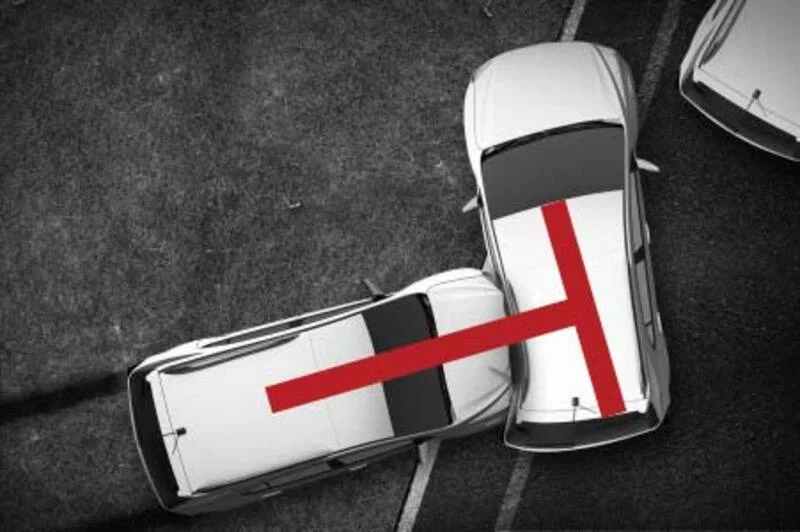
If you’ve ever heard someone say “I got T-boned,” you probably had a rough idea of what happened – but the term carries more legal and medical weight than most people realize. A t bone car accident isn’t just a fender bender; it’s one of the most dangerous crash types on the road, and figuring out who’s at fault afterward often comes down to a handful of very specific traffic violations.
This guide covers the t bone accident meaning, why these crashes happen so often at intersections, how injuries differ from a typical rear-end or head-on collision, and how liability gets sorted out when one vehicle slams into the side of another.
T-boned in a crash in New York? Talk to a car accident lawyer in Brooklyn at The Rybak Firm, PLLC. Free consultation: (718) 307-5554.
T-Bone Accident Meaning: What Actually Happens
A t-bone accident – sometimes called a side-impact or broadside collision – happens when the front of one vehicle crashes directly into the side of another, forming a shape resembling the letter “T.” Picture one car driving straight through an intersection while another car, traveling on the cross street, fails to stop in time.
The reason this t bone crash type is so often singled out for its severity is simple physics: the sides of a vehicle have far less crumple zone and structural protection than the front or rear. Even with side airbags and reinforced door frames, occupants – especially on the side that was struck – are exposed to much more direct force.
Where and Why T-Bone Crashes Happen
T-bone collisions are overwhelmingly an intersection problem. Whenever two paths of traffic cross at roughly a 90-degree angle – controlled by a light, a stop sign, or sometimes nothing at all – there’s potential for a t boned car accident if either driver misjudges timing, speed, or right-of-way. Whether people call it a t bone car wreck, a broadside hit, or just “getting T-boned,” the underlying mechanics are the same.
The most common causes include:
- Running red lights or stop signs – A driver who blows through a signal puts themselves directly in the path of cross traffic that has a green light or right-of-way.
- Distracted driving – A glance at a phone for even two seconds is enough to miss a changing signal or a vehicle entering the intersection.
- Failure to yield – Misjudging gaps in traffic when turning left, or pulling out from a side street without fully checking, is one of the most frequent triggers for a t boned crash.
- Impaired driving – Alcohol or drugs slow reaction time precisely when split-second braking is what’s needed to avoid broadside contact.
- Speeding through intersections – Higher speed means less time for the other driver to react, and a harder impact when a collision does occur.
Injuries Commonly Associated With a T-Bone Car Crash
Because the point of impact is so close to where occupants sit, a t bone car crash tends to produce a different injury profile than other collision types. Common injuries include:
- Broken bones – particularly ribs, pelvis, and the arm or shoulder on the impact side
- Head injuries, including concussions from striking the window or door frame
- Whiplash and other neck and spinal injuries
- Internal organ damage from the force of impact
- Long-term issues requiring physical therapy or ongoing treatment
The severity often depends on exactly where the impact lands – a hit near the front doors tends to be more dangerous than one further back, simply because of proximity to the driver and front passenger.
How Fault Is Determined After You’ve Been T-Boned
Working out who’s responsible after a t-boned crash usually comes down to reconstructing exactly what each driver was legally required to do at that moment – and who failed to do it.
| Crash Scenario | Driver Typically At Fault |
| Driver ran a red light/stop sign and struck cross traffic | Driver who ran the signal |
| Driver turning left was struck by oncoming traffic with right-of-way | Driver who turned left across traffic |
| Driver pulled out of a side street/driveway into a moving vehicle | Driver who pulled out |
| Both drivers had a green light due to signal malfunction | Often disputed – may involve the municipality/signal maintenance |
| Driver was speeding but technically had right-of-way | Fault may be split between both drivers |
Police reports, traffic camera footage, witness statements, and the position/damage of both vehicles are the main pieces of evidence used to reconstruct a t bone accident diagram showing exactly how the collision occurred. Because many states (including New York) follow comparative negligence rules, it’s also possible for both drivers to share a percentage of fault – which directly affects how much compensation either side can recover.
What to Do Immediately After a T-Bone Accident
What happens in the minutes and hours after the crash can make a real difference in how a claim plays out later:
- Call 911 and get medical attention, even if injuries aren’t immediately obvious – adrenaline can mask pain from a side-impact hit.
- Document the intersection – photograph traffic signals, stop signs, skid marks, and the final position of both vehicles before they’re moved.
- Get the other driver’s information along with contact details for any witnesses who saw the signal or the moments leading up to impact.
- Request the police report, which will typically include the responding officer’s initial assessment of fault.
- Avoid discussing fault at the scene – stick to factual descriptions and let the evidence speak for itself.
- Follow up on medical treatment, since some injuries from a t-bone impact don’t fully present until days later.
Why a T-Bone Claim Often Needs a Closer Look
A t boned accident can look straightforward at first – “the light was red” – but insurers frequently dispute exactly when a light changed, whether a driver had time to stop safely, or whether the other car was speeding enough to share blame. Because the injuries from a t boned car crash also tend to be more severe than average, the stakes of getting the fault determination right are higher than in a typical fender bender.
An attorney experienced with intersection collisions can pull traffic signal timing data, canvas nearby businesses for camera footage, and bring in accident reconstruction experts when the initial police report doesn’t tell the full story.
If You’ve Been T-Boned, Get Your Case Reviewed
If you or someone you know has been injured in a t bone accident, the details of who had the right-of-way and what evidence is available can change quickly – especially footage that gets overwritten within days. A free case review with a personal injury attorney can help establish what happened, who’s likely responsible, and what your next steps should look like while the evidence is still fresh.